Packing Your Bags for an International Trip
What is the most important thing
I take on my trip?
What is the SECOND most important thing
I take on my trip?
How should I organize my stuff?
What should I do about toiletries?
How many bags can I take?
What should I pack for first aid?
What kind of shoes are best?
How about a packing checklist?
What should I do about special food requirements?
What is the most important thing
I take on my trip?
The most important thing you are taking on this trip is YOU. Bear this
in mind if you find yourself in an emergency situation, such as a train
derailment, airline incident or violent crime. Forget your bags, forget your
passport, save yourself and those around you. Read a real-life, first-hand
account of such an emergency.
Back to top
OK... What is the SECOND most important thing
I take on my trip?
Your passport, airplane ticket and money should be carried in a security
belt. While you are in the airport, you will need these items for airline and
security personnel, so they should be secure, but readily available. Women often carry
them in a purse; men in a jacket pocket. In this discussion, "money"
means credit cards, cash, ATM cards and travelers checks. Once you are ready to leave the
airport, visit the restroom and transfer your passport, airplane ticket and the bulk of your money to
your security wallet, under your clothes. Women may find that a sports bra is a
comfortable, convenient means of carrying their documents.
If at all possible, get electronic ticketing (E-Tickets) from your airline. There is
nothing to lose, nothing to get stolen.
Back to top
How should I organize my stuff?
Your passport, airline ticket and
money should be in a security wallet, worn underneath your clothes. Keep a
smaller amount of cash in your pocket or purse for incidentals. Remember the
"1+1" rule under the new TSA regulations. You may carry on board the aircraft
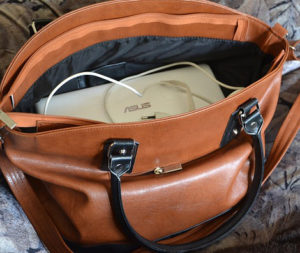
one bag that will fit the airline sizing templates, plus a small "personal" item
such as a lady's purse, computer case, briefcase or daypack.
Pack a small "in-flight" bag that will hold essentials for
your flight. Consider the following for an "in-flight" bag:
- Reading material
- Prescription eyeglasses, contact lens accessories, reading glasses
- Hearing aids, batteries
- Facial tissues
- Personal stereo plus CD's or cassette tapes (music or audio books)
- Prescription medicine, especially including diabetic kits if necessary.
Note that with increased , post-9/11/01 security, diabetics may need an official letter
from their doctor. Check with the airline well in advance of your trip.
- Crossword puzzle, word-search books
- Comb, brush, toothbrush, toothpaste and collapsible drinking cup (the
airplane lav may or may not have paper cups)
- Makeup, earrings
- Electric razor and shaving mirror. A man can shave with a battery-powered
electrice razor at his seat.
- Laptop computer or handheld device
- Addresses for postcards
- Snacks, bottled water
- Travel-sized backgammon or chess set. Playing cards.
- Small container of cologne
- Hand-held electronic toy (for you and the restless kid in the next
aisle)
- Feminine hygiene products and any necessary medicine, in original
containers. (Put these in your in-flight bag if you within
several days of needing them. Air travel can interrupt women's monthly cycles.)
You might consider packing a carry-on bag that will hold enough clothing to
carry you through a couple of days should your checked luggage be lost or
delayed. The carry-on bag is stored in the overhead bin and not touched during
the flight. In addition to two or three days changes of clothing and underwear, the following
should go in your carry-on bag:
- Emergency food rations, should you have dietary
restrictions
- Jewelry or any sort of heirloom
- Photographs or anything with sentimental value
- Anything irreplaceable
- Prescription medicine (original, pharmacy-labeled bottles)
- Important business or personal documents
- Toiletries
- Keys: Your house keys, car keys and luggage keys. Consider leaving other,
non-essential, keys at home.
- Any clothing of any personal significance, such as special occasion dress, clerical vestments, heirloom clothing. Anything that you must wear the
day after arrival, such as business clothing, should go in your
carry-on.
If you have a lot of important, irreplacable stuff to take on your trip, such
as a wedding dress or a large amount of paper, think about shipping it to your
destination a week or so in advance by insured courier, such as FedEx or UPS. Confirm it's arrival, then
pack light and fly worry-free.
Due to heightened security procedures, your carry-on luggage may be
completely hand-inspected. You are well-advised to carry the minimum amount of
carry-on luggage and check the rest. A side-effect of the passenger-checked
luggage matching procedures is that the chances of your bags getting lost is
lower than it was before.
Please be aware that you will have to lift your carry on bag to the overhead
bin yourself, unless you are disabled. The airline flight attendants are only
legally obliged to assist disabled passengers. They may assist you, but if you
cannot manage your bag alone, it is doubtful that a flight attendant could do any
better. You as a passenger do not have the right to demand the flight attendant
stow your heavy carry on bag in the overhead bin for you. This is a
"hot" issue these days and flight attendants are very aware of
union, OSHA and airline rules regarding stowing passengers bags for them.
Airline flight attendants are legally required to assist disabled passengers
stowing carry on bags under the seat in front of them. They are not required to
lift bags to overhead bins.
Please note that following 9/11/2001, carry
on baggage is severely restricted. Pack, for example, a paper nail file rather
than a sharp metal one. If you need things like scissors or knives at your
destination, consider buying or borrowing some when you arrive, or pack them in your checked
luggage.
Finally, the bulk of your clothing and other belongings should go in your checked luggage.
Our thanks to the CompuServe Travel Forum for an in-depth discussion of
the issues of flight attendants assisting with carry-on luggage. Larry
and Leslie were especially helpful.
Back to top
What should I do about toiletries?
If you are planning to be away a week or two, then it's best to pack enough
toiletries to see you through the entire trip. If you will be away longer, then
pack at least one week's supply. While you are at your destination, you should
consider searching for replacements when you are down to about a week's supply
of any item.
Why? Because you might run into a situation where stores are closed early, or
closed for several days due to a national holiday. You might be so busy with
touring and sightseeing that at the end of the day you might not have the energy
to go out and find a pharmacy.
Don't pack too much by way of toiletries, since you can buy supplies while on
the road. However, do not wait until the last minute to buy supplies. You may
find yourself stuck.
Larry, a pilot with a commercial air freight company, has this to say:
"One suggestion that I'd pass along is to have a separate toiletries kit for
traveling. That way you don't have to pack your 'bathroom stuff' for the trip
nor unpack it when you return.
"What I do for keeping the travel bag supplies fresh and full is that whenever I
get out a new bottle of (fill in the blank) the new bottle goes into the
suitcase and the partially used one from the suitcase moves into the bathroom.
That way I don't ever run out while on the road."
How many bags can I take?
Check with your airline first, either on their web page or by phone for exact
regulations. However, in general international passengers are allowed three
bags. Recently, the FAA has cracked down on the size and weight of carry-on
bags. Passengers are permitted only one carry on item and one
"personal" item, such as a small backpack, purse, briefcase or
computer case. (See discussion above about assistance in
stowing carry on luggage in overhead bins.) Remember the "1+1" Rule. One carry
on bag plus one personal item.
A painless way to organize for a long international flight is to pack a
rolling, regulation-sized carry-on bag with a change of clothes and other
irreplacable items and essentials. Inside the carry-on bag, pack your
"in-flight" small tote bag. Zip the carry-on closed, and as you pass security
and board the aircraft you will have "one" bag, plus any personal item such as a
purse, but passport and tickets in a security wallet.
Once aboard, open your carry-on bag and remove the "in-flight" tote bag and
put it under the seat in front of you. Close the carry-on bag and stow it in an
overhead bin. Now you have your spare clothes and other irreplaceable items with
you in the cabin overhead bin, plus the convenient "in-flight" tote bag with
only the stuff you might need in the airplane at your feet.
Note that taking more than three bags, even if they are small bags, can
result in excess baggage charges. Various airlines have recently announced that
they
will charge excess baggage charges even for a third checked bag. Check with your
airline in advance of your trip!
Back to top
What should I pack for first
aid?
Imagine waking up in the middle of the night in your hotel room with
"something wrong". If you were at home, a simple visit to the bathroom
medicine chest would cure your ills enough to allow you to go back to sleep.
However, here you are on the road and a simple hangnail, dry throat or upset
stomach is keeping you awake.
Consider packing a first aid kit with small packages of
remedies. This should be enough to get you through the night. If the problem is
still with you in the morning, then you can seek proper medical care at a
doctor's office, clinic or pharmacy.
Some suggestions:
- Adhesive bandages in several sizes
- Upset stomach remedies
- Throat lozenges
- Cold medicine, decongestants
- Laxative
- First aid cream and sunburn cream
- Petroleum jelly
- Eyeglasses repair kit and soothing eye drops
- Ingrown toenail remedies
- Insect repellant
- Feminine hygeine supplies and associated medicine
- Aspirin, ibuprofen or other headache remedies
- Gauze pads and adhesive dressing
- Tweezers, needle and pack of matches for sterile removal of a splinter. These
items need to go in your checked luggage, and cannot be taken on board in
hand luggage. If your eyeglass repair kit has a screwdriver, it should also
go into checked luggage.
Your first aid kit should take a small corner of your carry-on bag.
Take small containers and pack spillable items in zip-lock bags.
Back to top
What kind of shoes are best?
While traveling by air, you may be asked to remove your shoes for security
inspection, so easy slip-on, slip-off, comfortable shoes are best. These kinds
of shoes are best for the flight, as well. You can slip them off your feet,
wiggle your toes and rotates your ankles. Consider metal-free shoes so they will
not set off the security metal detector.
If you plan to do a lot of walking, and most tourists do a lot of
walking, pack sensible shoes. The classic advice is best: Buy well-made,
name-brand shoes and pay as much as you can afford. Take at least two pairs, so
you have one to wear if the other pair gets wet. Break them in before leaving
home.
Many people ask about sneakers in the city. If you are an adult, white
sneakers in Europe will brand you as a tourist. Is that all that bad? Well, not
really, since you are, in fact, a tourist, but it does attract the attention of
pickpockets who target tourists. It's better to blend in with the crowd. You can
find comfortable dark-colored suede or leather shoes that should suit your needs
perfectly.
If you are young enough in age or spirit to travel with your belongings in a
backpack and sleep in hostels and city parks, then jeans and sneakers are fine.
If you are of the rolling luggage and hotel room with private bath generation,
then forget the sneakers.
Thanks to Fred Osterholtz for the reminder to write about appropriate shoes
for the tourist.
How about a packing checklist?
We like the packing checklist from the good folks at Eagle
Creek. We also like their products.
What should I do
about special food requirements?
Lots of people have special dietary requirements for medical, religious,
weight-control reasons or just personal preference. You can order special meals
from the airline in advance, but be aware that they usually require a certain
lead time, say 48 hours, before flight departure. If you have a special dietary
requirement, then you are best advised to check out the webpage for your airline
and look at their meal choices as well as their advance notice requirements.
When you confirm your flight, and when you later check in at the airport, you
should also confirm your meal request. Many people go so far as to confirm at
the gate check-in area.
You must, however, be prepared for the eventuality of the flight being
delayed or the meal request not making it to the plane. Ask yourself what you
would do if, for example, you check in for your flight and find that your plane
is delayed for weather, air traffic control or mechanical reasons, or for some
reason you have to take a later or earlier flight. Could you eat the food at the
airport? Could you eat the food at a hotel where you have an unexpected layover?
What if, for example, kosher or halal food was served to you in an unsealed tray? What
would you do? What about your children and their special dietary requirements?
The nightmare scenario, as we all know, took place on Sept 11, 2001. As well
as the shock and horror of terrorist attacks on US soil, many air travelers were
stranded for days, not just hours, in unfamiliar surroundings. It
is worth stopping for a few moments and think about what you would do if for
some reason, you were similarly stranded for long periods of time. Let's hope,
shall we, that the reason would be as simple as inclement weather and not another day like
9/11/01.
We strongly recommend anyone with special dietary requirements take food
along with them. Travelers Club
makes a line of convenient food coolers, including one that can be pulled on
rollers just like a "roll aboard" carry on suitcase. It has a
telescoping handle and heavy duty rollers. Such a rolling cooler might be
suitable for a family. They make smaller, shoulder-tote and backpack coolers
that might be suitable for a couple or a single traveler. If you take food that
does not need to be kept cold, a rolling backpack like those used by junior high
school students might be ideal.
If you are traveling with children, packing food that you know they like and
that you as the parent know is good for them might save your sanity. Travel for
children is upsetting enough and being served unfamiliar, icky food is a
precription for disaster. There are many kid-sized rolling carry on bags just
right for a little stash of familiar food, a change of clothing and a few toys,
games, blankie and other things to occupy the child during the flight.
Finally, if you do plan to take food with you, then check out the websites
for the foreign and US
Department of Agriculture services regarding what kind of food can be
imported. Cheese, nuts, bakery goods and bread are on the General List of
Approved Products, however you should read the USDA website carefully before you
pack. Note that meat is almost completely forbidden to import, especially in
these days of mad-cow and hoof and mouth scares. With this in mind, a observant Jewish
family, for example, would probably pack a "dairy/pareve" set of
emergency food in the traveling pack or cooler.
Previous | Next
05/23/2005
|